AI Can Now Build Software. That Doesn’t Mean It Understands It.
Originally published on LinkedIn on 2026-03-09. Republished here by Akash GR.
In my previous article, I discussed the shift from automation to autonomation, the evolution of software from systems that simply follow predefined workflows to systems that can reason about goals, orchestrate tools, and figure out how to achieve outcomes.
As AI agents begin to sit on top of APIs, data, and services, software itself is becoming more capable of planning and executing tasks dynamically. In many ways, AI is the technology that makes autonomation possible, enabling systems to reason about problems and coordinate actions across tools.
But while this transformation is happening inside software systems, something equally important is happening around them. The tools used to build software are becoming autonomous as well.
We’re entering a phase where generating software is becoming easy, but judging whether that software is actually good is becoming the real skill.
Modern AI coding systems can now generate APIs, scaffold applications, integrate services, and even debug complex logic. Tasks that once required days of engineering effort can now happen in minutes. The speed at which working systems can appear has increased dramatically, and in many ways this changes the dynamics of software creation.
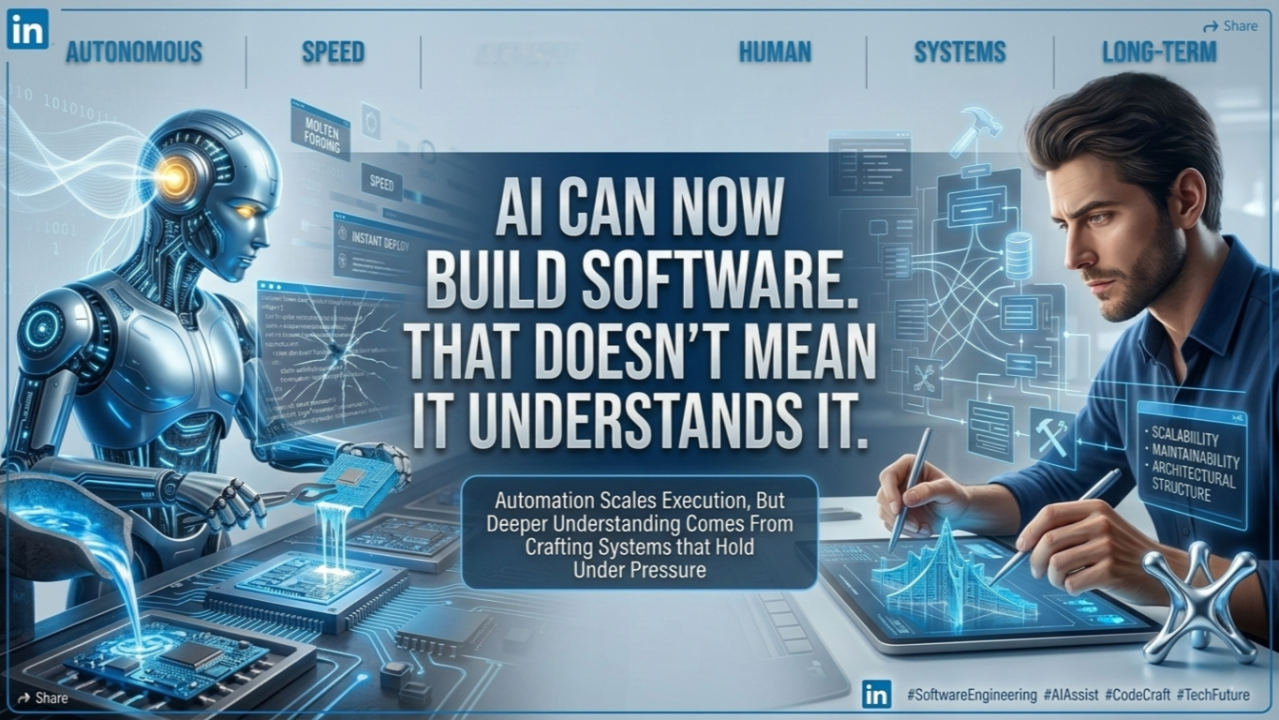
Claude Code has essentially handed everyone a forge.
The problem is that not everyone knows how to work with gold.
The same tool that allows a great engineer to design and ship a robust system in days can also allow someone else to confidently deploy something fragile at ten times the speed. When the barrier to generating software drops, the difference between understanding systems and simply producing code becomes much more visible.
There is a popular narrative that AI tools dramatically raise the floor, making everyone equally capable of building complex systems. But what we are beginning to see may be slightly different. AI seems to raise the ceiling much more than the floor.
For people who already understand systems, architecture, scalability, and long-term maintainability, these tools remove friction between idea and execution. They allow experienced builders to move faster while still making thoughtful design decisions. For others, AI can generate systems that look impressive on the surface while hiding deeper structural problems.
This is simply the nature of leverage. Powerful tools amplify both good judgment and weak judgment.
Another interesting effect of AI-assisted development is how quickly something can appear production-ready. Endpoints respond, interfaces render correctly, and features seem complete. From the outside, everything looks like a working system.
But software rarely fails during demos. And lately, a few successful prompts have convinced many people they’re now software engineers.
Most failures appear later in scaling behavior, architectural limitations, unexpected edge cases, and operational complexity. These are the areas where experience and systems thinking matter the most. AI can generate large amounts of code quickly, but the deeper context required to build durable systems still comes from understanding how software behaves in real environments.
Writing software is easy. Living with it in production is where the real engineering begins.
This is the quiet shift happening right now. Automation helped software scale execution. Autonomation is beginning to scale decision-making. And now AI is starting to scale software creation itself.
That makes the tools incredibly powerful. But powerful tools have always followed the same rule: they do not replace expertise they amplify it.
The forge is now available to everyone. The real question is whether the people using it understand how to shape something that actually holds under pressure.
Because powerful tools expand what we can build, but they don’t replace the craft required to build it well.
Earlier in this series: Automation → Autonomation: The Next Shift in Software.