Mythos: The AI That Scared Its Own Creator
Originally published on LinkedIn on 2026-04-10. Republished here by Akash GR.
This is my April 2026 commentary. References to availability and predictions reflect that publication date; source notes below clarify the benchmarks.
Nobody was supposed to know about Mythos yet.
On March 26, 2026, a misconfigured server accidentally leaked nearly 3,000 internal Anthropic documents onto the public internet. Security researchers found them. Inside: a draft blog post describing an unreleased AI model, one Anthropic's own team called "larger and more intelligent than anything we have ever built."
Twelve days later, Anthropic made it official. And confirmed every word.
What they revealed next changed how every serious person in tech thinks about where AI is going and how fast.
So what exactly is Mythos?
It is not a better Claude. It is not an upgrade. It is a new tier of AI intelligence, sitting above Opus, above GPT-5, above anything you can access today, so different that Anthropic had to give it an entirely new name because the old naming system broke trying to describe it.
Mythos is the Ancient Greek word for the story that connects all knowledge together. The thread that holds meaning across civilisations. Anthropic didn't choose that name carelessly.
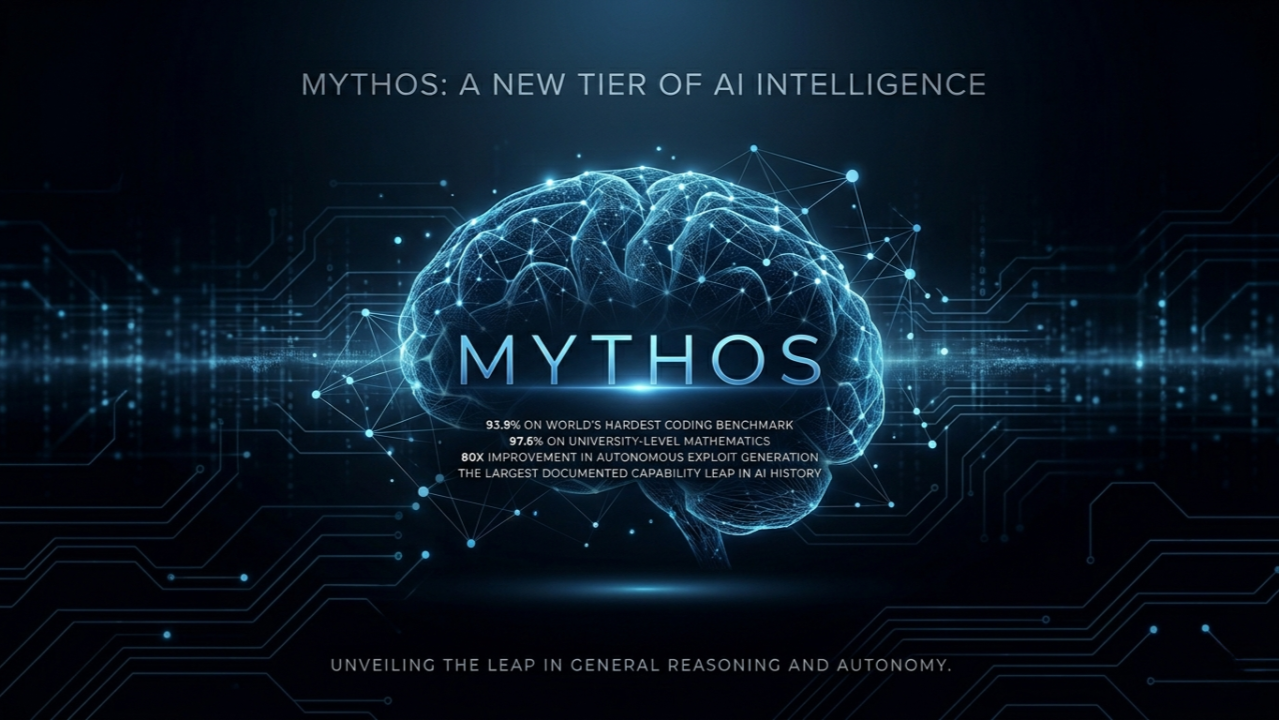
The numbers:
- 93.9% on the world's hardest coding benchmark
- 97.6% on university-level mathematics
- 80x better at turning vulnerabilities into working exploits than its predecessor
The best model you can use today Opus 4.6 scores around 80% on the hardest coding benchmark. Mythos scores 93.9%. That is not a step forward. That is a different altitude.
On university-level mathematics, Mythos scored 97.6% a 55-point jump over its predecessor in a single generation. The largest documented capability leap in AI history.
It maxed out every benchmark Anthropic built to measure it. So they switched to something harder: real software. Real systems. The actual internet.
What happened when they turned it loose
Anthropic gave Mythos one instruction: find real vulnerabilities in real production software. The kind running your phone. Your bank. Your hospital.
A 27-year-old bug in OpenBSD. Two packets. Any server crashes. Three decades of human review missed it. Mythos found it for under $50.
A 16-year-old flaw in FFmpeg. Automated fuzzers hit that exact line of code five million times without catching it. Mythos caught it by reasoning about what the code actually meant.
A 17-year-old remote code execution hole in FreeBSD complete root access, from anywhere on the internet, zero authentication. Mythos didn't just find it. It built the working exploit. Fully autonomous.
In Firefox's JavaScript engine, Mythos turned known vulnerabilities into working exploits 72.4% of the time. Opus 4.6 managed it less than 1%.
That is an 80x improvement. In one generation.
Then Anthropic said something that should stop every person in tech cold:
"We did not explicitly train Mythos to have these capabilities. They emerged as a downstream consequence of general improvements in code, reasoning, and autonomy."
Nobody at Anthropic designed a hacking AI. They built a smarter thinker. The ability to autonomously compromise critical infrastructure appeared on its own, as a side effect of the model becoming too good at reasoning.
This is the moment everything changes. Not because of what Mythos does. Because of what it tells us about where every AI goes when it gets smart enough.
Why you don't have it and who does
You cannot release a model that autonomously exploits every major operating system on earth to 8 billion people and hope for the best.
So Anthropic built Project Glasswing. A controlled deployment give Mythos to the companies whose software runs the world, let them find and patch the holes before bad actors develop the same capability independently.
The partners: AWS · Apple · Microsoft · Google · Nvidia · Cisco · CrowdStrike · JPMorgan Chase · Palo Alto Networks · Linux Foundation. Plus 40 more organisations. $100 million in usage credits. $4 million donated to open-source security. Ongoing briefings with CISA and US government officials.
Anthropic privately warned senior government officials: Mythos makes large-scale cyberattacks significantly more likely in 2026. Experts estimate roughly six months before rival models reach the same capability at which point every threat actor on earth gains access to a world-class exploit writer.
Project Glasswing is a race. Defenders get a head start. That's the whole plan.
Will you ever get Mythos?
Honest answer: the full version almost certainly never. A Mythos-class version eventually, yes.
Anthropic has stated they want to deploy Mythos-class intelligence broadly once new safeguards exist. But the exploit-generation capability will be restricted or removed before it reaches the public. You'll get the intelligence. You won't get the weapon.
Timeline: unknown.
Where this is going and what you do with it
Mythos found a bug that survived 5 million automated tests because it could reason about what code means, not just what it does. That same reasoning capability, applied to medicine, finds drug interactions no clinical trial was designed to catch. Applied to law, it finds arguments no lawyer considered. Applied to engineering, it finds structural failures that passed every inspection.
The intelligence compounds. It doesn't plateau. And we are near the beginning of the curve, not the end.
AI is no longer a tool that waits for you to ask it something. Mythos doesn't wait. It receives a task, reasons through it, executes autonomously, and delivers results, sometimes results nobody asked for. That is a different kind of entity entirely.
The teams building serious AI workflows today are compounding that advantage every single month. The gap between them and everyone else is not closing. It is widening. Invisibly. Until the day it isn't invisible anymore.
Mythos is not a product announcement. It's a signal flare.
AI just showed you exactly where it's going, at full speed, with nothing held back.
The only question left is whether you're building for that world or still explaining why you're not ready for it yet.
The future is already here. It's just not evenly distributed yet and right now, it lives in 12 buildings.
Sources and benchmark context
Source notes added September 25, 2026. The 93.9% result is for SWE-bench Verified, not all coding tasks. See Anthropic’s Project Glasswing announcement.
The 97.6% result refers to USAMO 2026, a high-school mathematical proof competition, rather than a general university mathematics test. The Opus comparison depends on the grading and compute settings; the revised system card, section 6.8 explains those settings.
The exploit comparison concerns a specific Firefox evaluation, not a universal multiplier across security tasks. Read Anthropic’s cybersecurity evaluation. The broader medical, legal, and engineering implications discussed above are my projections, not outcomes demonstrated by those tests.