From Software That Waits to Software That Works
Originally published on LinkedIn on 2026-03-19. Republished here by Akash GR.
For 20 years, we built software that was exceptional at one thing.
Waiting.
Waiting for you to log in. Waiting for you to fill the form. Waiting for you to pull the report. Waiting for you to make the call.
We called it productivity software. We called it a platform. We called it digital transformation.
The Passive Infrastructure Era
SaaS changed where software lived. Not what software did.
Before SaaS, software sat on your desktop. After SaaS, it sat in the cloud. But in both cases it sat.
You were still the engine. Software was the vehicle. And you had to show up every single day to start it, steer it, and park it.
That's what "workflow software" actually means. A system built on the assumption that a human will always be present to do the work.
Your CRM doesn't follow up with leads. You do.
Your HRMS doesn't resolve attrition risk. You do.
Your project management tool doesn't unblock dependencies. You do.
The software logged it. You solved it.
This wasn't a flaw in SaaS. It was the design. The entire model was built around human-operated systems, tools that amplified human effort, not tools that replaced human presence.
And for two decades, that was more than enough.
What Changed Isn't AI. It's Agents.
The biggest mistake people make right now is calling this an "AI moment."
It's not. It's an agentic moment.
Putting an AI assistant inside a SaaS product is like putting a GPS inside a horse cart. Useful, sure. But you're still in the cart. Someone still has to hold the reins.
The real shift, the one that actually matters is the emergence of software that doesn't wait for instructions. Software that acts on intent.
Here's the cleanest way I can frame the difference:
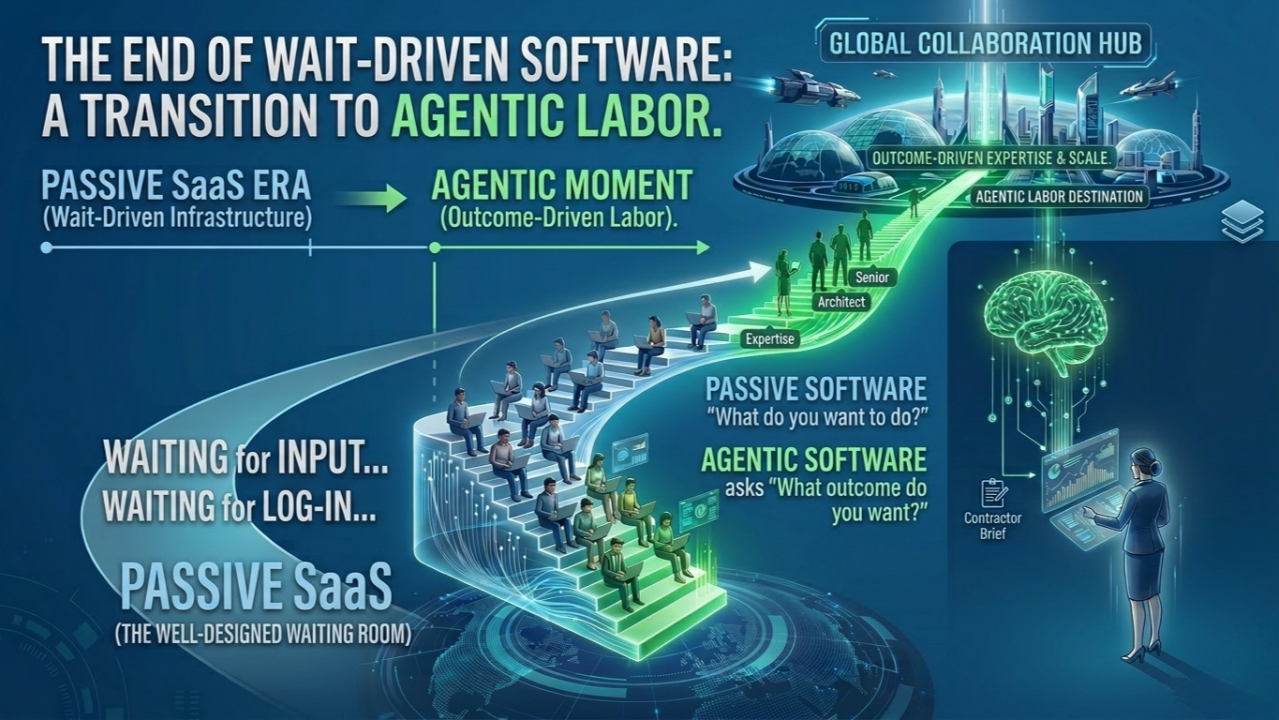
Passive software asks: "What do you want to do?" Agentic software asks: "What outcome do you want?" and then goes and gets it.
One requires your presence. The other requires only your judgment.
That's not a feature upgrade. That's not a product iteration. That's a category shift, the kind that happens once every 15–20 years in software.
"Passive software asks what you want to do. Agentic software asks what outcome you want and goes and gets it."
Software as Labor, Not Software as Tool
Here's the terminology shift that changes how you see all of this.
We've spent 30 years buying software as a tool, something you pick up, use, and put down. Its value was entirely dependent on how well you operated it. A bad operator got bad results. A great operator unlocked the ceiling.
Agentic software is labor. Something you hire, brief, and hold accountable for output.
And that distinction breaks everything open.
A tool sits idle when you're not using it. Labor doesn't, it keeps working.
A tool does exactly what you operate it to do. Labor applies judgment within a defined boundary.
A tool breaks when the input is wrong. Labor flags the problem and asks for clarification.
A tool scales only as fast as you can operate it. Labor scales independently of your bandwidth.
This is precisely why pricing is shifting from per-seat to per-outcome. You don't pay a contractor for the hours they sit at their desk. You pay them for what they deliver.
Agentic software is the contractor. The SaaS dashboard was the desk.
The desk was never the point.
The Stack Gets Smaller. The Stakes Get Bigger.
The average mid-size company today runs 40 to 60 SaaS tools.
Every tool is a silo. Every silo needs a human to move data between them. Every human movement is a delay, an error, and a cost that compounds invisibly across the organization.
Agentic software doesn't upgrade this stack. It compresses it.
Not because agents are smarter than dashboards, but because an agent operates across systems rather than inside one. It doesn't live in your CRM or your outreach tool or your calendar. It lives at the goal layer, orchestrating whatever systems it needs to reach the outcome.
You don't need a tool for outreach, a tool for CRM updates, a tool for follow-up scheduling, and a tool for pipeline reporting.
You need one agent with a clear goal: "Move this deal forward. Here's the context."
Fewer tools. More trust. Higher accountability per system.
This is the part most SaaS founders are not ready to hear, your product's survival in the next decade depends less on your feature roadmap and more on whether your product is an agent or a dependency of one.
What Survives and What Doesn't
Not all SaaS dies in this transition. But the SaaS that survives looks radically different from what's winning today.
What survives is the system of record layer, the databases, the source-of-truth infrastructure, the audit trails that enterprises can't live without. These become the substrate that agentic software reads from and writes to. They don't go away. They become more important, and far less visible.
What doesn't survive is the interaction layer.
The dashboards nobody actually reads. The notification systems that produce noise instead of signal. The workflow builders that still require a human to design, maintain, and monitor every automation. The "productivity tools" that added value purely because a human was operating them.
Strip the human out and half of your SaaS stack becomes overhead.
Here's the uncomfortable truth: the graveyard of the next decade won't be full of bad SaaS companies. It will be full of good ones, companies that built genuinely useful products, grew strong revenue, and still got disrupted because they solved the wrong problem.
Making human work faster, instead of making human presence optional.
Those are two very different bets. And the market is about to price them accordingly.
The Builder's Question
If you're building software today, whether you're a founder, a PM, or an engineer with product instincts, there is one question worth sitting with:
Is your product valuable because a human is using it? Or is it valuable because a job is getting done?
If it's the former, you're building passive infrastructure in an active-labor world. You're betting that the human will always show up, always know what to do, and always have the bandwidth to operate your tool correctly. That's a fragile bet.
If it's the latter, you're building something that compounds. Because the job getting done doesn't care what time zone the user is in. It doesn't care whether they remembered to log in today, or whether they had a brutal morning and skipped the weekly review.
The software that wins the next decade isn't the most feature-rich. It isn't the most beautiful. It isn't the one with the best NPS score.
It's the software that works hardest when you're not watching.