I Haven't Written a Single Line of Code in 6 Months. Here's the Ground Reality No One Is Talking About.
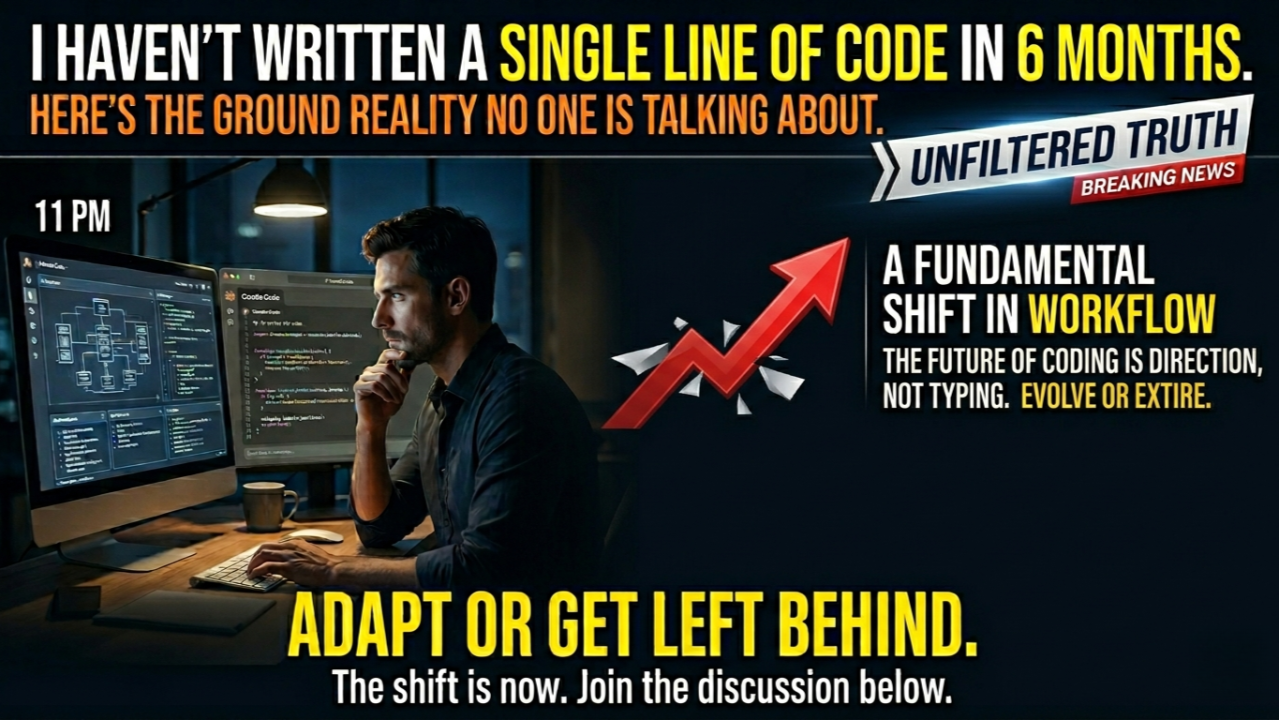
Originally published on LinkedIn on 2026-04-20. Republished here by Akash GR.
Let me say something that the people talking about AI on LinkedIn won't tell you.
I am a Tech Lead. I build solutions for real problems.
And I have written zero lines of code in the last six months.
Not because I got promoted out of it. Not because I'm lazy. Not because I forgot how.
Because AI is writing the code.
I treat AI like my best employee. I give it the problem, I review the work, I catch what it misses, and I ship. That's the job now.
Every day on LinkedIn, the people talking about AI are posting about how AI is a "multiplier" for developers, how it "10x's your output," how you should "stay curious and keep upskilling."
And they're not wrong, They're just not living through it.
I am. And the ground reality looks very different from the ground.
Here's what actually happened to my workflow over the last six months:
I stopped writing functions. I started describing systems.
I stopped debugging line by line. I started reviewing outputs and asking better questions.
I stopped opening a code editor to write. I started opening one to read, verify, and ship.
The output is the same or even faster. The process is unrecognizable.
The thing most people miss is this:
Code was never the job. Code was how we showed our work.
When I was a backend engineer, I wasn't hired to type syntax. I was hired to solve problems, design systems, and make things work reliably at scale.
Code was the medium of expression.
AI just changed the medium.
The thinking? Still mine. The architecture decisions? Still mine. The product judgment, the trade-offs, the "this will break in production" instinct? Still mine.
We ship. That hasn't changed.
What has changed is terrifying for people who optimized only for the craft of coding and liberating for people who always cared more about the problem.
I made my choice early. I leaned into AI completely.
And I'm not looking back.
If you're still on the fence, waiting to see how this plays out, I'll tell you what the hesitation is costing you. Every sprint someone else is shipping faster. Every week the gap between those who adapted and those who didn't grows wider.
This isn't about loving or hating the craft of typing code.
This is about outcomes. And right now, the people who've embraced AI are winning on outcomes.
The people talking about AI on LinkedIn won't tell you this because most of them are selling courses, not building products.
They're not in the trenches at 11 PM watching Claude Code ship the Product while you review the architecture and catch the edge case it missed.
They're not watching their team go from "we need 3 sprints for this" to "we demoed it today."
They're not navigating the new skill gap, which isn't "can you use AI?" but "can you think clearly enough to direct it?"
That's the real question now.
To the new developers and IT aspirants reading this:
Don't let anyone tell you that learning to code is pointless now.
That's wrong.
But understand why you're learning it.
You're not learning to code so you can type faster than an AI. You're learning it so you can think in systems. So you can read what AI generates and know when it's wrong. So you can catch the edge case at 11 PM that the model confidently missed.
The developers who will struggle are the ones who learned coding as a mechanical skill, syntax over thinking.
The ones who will thrive are those who learned it as a problem-solving language.
Learn the fundamentals. Understand the architecture. Build things that break and fix them yourself first.
Then let AI accelerate you. Not replace that foundation.
To the senior engineers and veterans who think AI won't touch them:
I respect you. Your experience is real. Your instincts are hard-earned.
But I need to say this directly:
"AI can't replace me" is not a strategy. It's comfort.
The question was never whether AI replaces you. The question is whether someone using AI replaces your role.
And that answer is already yes, in some teams, in some companies, right now.
Your 10 years of experience is still valuable. But only if you're willing to evolve what you do with it.
The engineers I see thriving aren't the ones resisting AI. They're the ones whose deep experience now makes them incredible directors of AI, because they know where it cuts corners, where it hallucinates, where it needs a human who has actually seen production burn.
That's your edge. Use it.
I've been sitting on this confession for a while.
Because it sounds like I'm bragging. Or panicking. Depending on which way you read it.
I'm doing neither.
I'm just reporting from the field.
Zero lines of code.
Still solving. Still designing. Still shipping.
The job changed. The craft didn't disappear it moved upstream.
Whatever stage you're at just starting out, mid-career, or a decade deep, the shift is real and it's happening now.
The best time to adapt was last year. The second best time is today.
Drop your experience in the comments. Let's have the real conversation.