Your Next Customer May Choose You Before Visiting Your Website
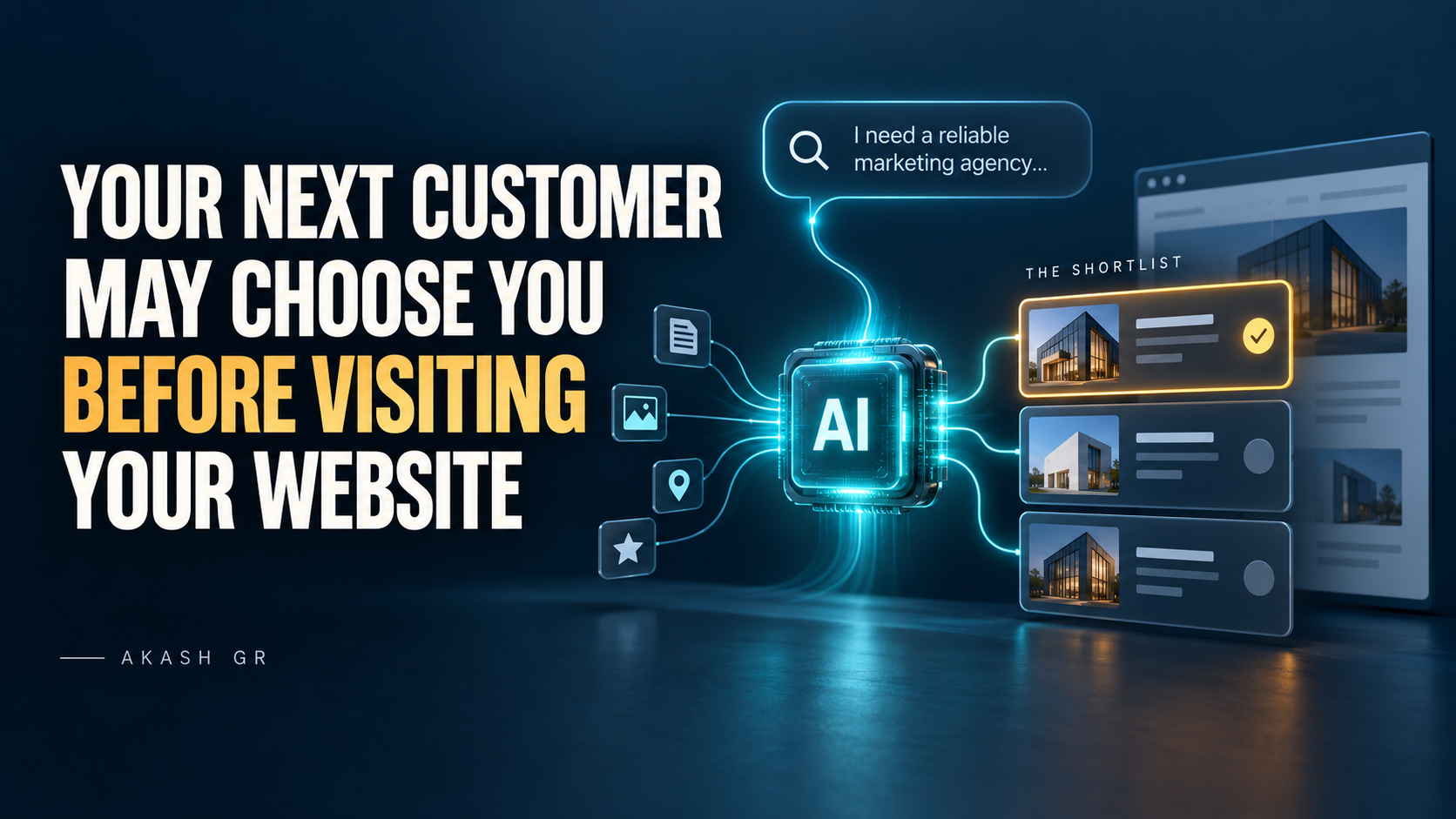
Imagine a customer asking an AI assistant:
“Find me three companies that can solve this problem, work within my budget, and support us after delivery.”
They ask a few more questions, compare the options, and decide which companies to contact.
Your business could be a good fit. But if you never appear among those options, your website may never get a visit.
We spend a lot of time improving what customers see when they land on a website. Now, part of their evaluation can happen before they get there.
We can already see this in shopping:
Salesforce reports 200% year-over-year growth in starting shopping with agentic search, including external AI conversations and retailers’ own assistants.
NIQ found that 51% of U.S. respondents used an AI-powered shopping tool in the previous month to support their buying decisions.
What interests me is how these answers get put together.
A model has knowledge from its training. A search-enabled assistant can also retrieve information while answering a question and use that material as context. This is the idea behind retrieval-augmented generation, or RAG: give the model relevant external information to work with, without retraining it each time something changes. How retrieval works
That distinction matters for businesses. Your latest pricing, a new service, or an updated product specification could enter an answer through retrieval, even if it was never part of the model’s original training.
Now take the customer’s request.
It contains several requirements: the problem, budget, location, delivery expectations, and support. A search system can break that request into related searches and gather information from different sources. Google calls this query fan-out in its AI search features. How Google describes it
The assistant can then use the retrieved material to compare options against the customer’s requirements.
So the answer depends partly on which information gets found and selected. A business might be relevant to the customer but poorly represented in the material available to the assistant.
And retrieval does not automatically make an answer correct. Old pricing, conflicting descriptions, or missing context can still lead to a misleading comparison.
The information available about your business becomes part of the customer’s evaluation, even when you aren’t in the conversation.
Agentic systems can take this further.
With the right integrations and permissions, an agent can call tools or APIs to check information or carry out an action. The model selects a tool and supplies its inputs; the surrounding software executes it and returns the result. The agent can use that result to decide what to do next. How agent tool use works
For example, a connected booking system could let an assistant check available appointments before suggesting a time. A commerce integration could provide current stock and pricing.
These capabilities depend on what the platform supports and what the business has connected. Putting a website online does not automatically give every agent access to its systems.
This is why I think business owners need to understand two things: how their business gets discovered, and what an assistant can reliably learn or do once it finds them.
A well-written description helps explain the offer. Current, consistent information helps support the comparison. Where transactions or bookings are involved, the quality of the integration matters too.
Those are different problems, and they need different work.
If an assistant never finds your business, rewriting the sales pitch alone may achieve very little. If it finds you but describes an outdated service, the issue may be the information it retrieved. If it recommends you but cannot complete an available booking, the problem could be in the connection to that system.
That is the part worth investigating before spending money on promises of “AI visibility.”
Different assistants use different sources, tools, and methods. One favourable answer does not establish that your business will consistently be recommended.
I would want to understand where the gaps are and which ones matter to actual customers.
The evidence is clearest in retail today. For other businesses, it is worth finding out how customers use AI during their research and whether the available information represents the business properly.
Your next customer may already be comparing options before you know they exist.
If you’re wondering what this means for your business and where to begin, feel free to reach out. Happy to talk it through.