The Disappearing First Step of a Career
Originally published on LinkedIn on 2026-03-12. Republished here by Akash GR.
In my previous articles, I discussed two shifts. First, software is evolving from automation to autonomation, where systems reason about goals instead of executing rigid workflows. Second, AI is beginning to generate software itself, dramatically reducing the effort required to build working systems.
But those two shifts lead to a third consequence that is only starting to become visible. When software becomes easier to create, the structure of the software workforce changes.
For decades, building software required large engineering teams. Not because systems were conceptually complex, but because the amount of code that had to be written manually was enormous.
Implementation work dominated the process. Engineers spent their time writing APIs, connecting services, building interfaces, and maintaining integrations. Large teams existed because execution required people.
AI changes that equation.
Modern coding systems can now generate large portions of applications in minutes. APIs appear instantly, boilerplate disappears, and integrations write themselves. The amount of mechanical coding work required to build software is shrinking.
When the amount of work changes, the shape of teams changes. Many startups are already experimenting with a different model: smaller engineering teams with higher leverage per engineer.
AI now handles large parts of the implementation layer. Some founders describe companies built with two engineers and AI tooling where ten engineers once would have been required.
This does not mean software engineers disappear. Software continues to expand into every industry. But something important is happening inside the profession.
The value of engineering is shifting upward.
If AI handles much of the implementation layer, the remaining work concentrates around:
- system architecture
- reliability
- scaling behavior
- operational complexity
- long-term system evolution
In other words, the core job becomes less about writing code and more about designing systems that survive reality.
This is where the real disruption begins.
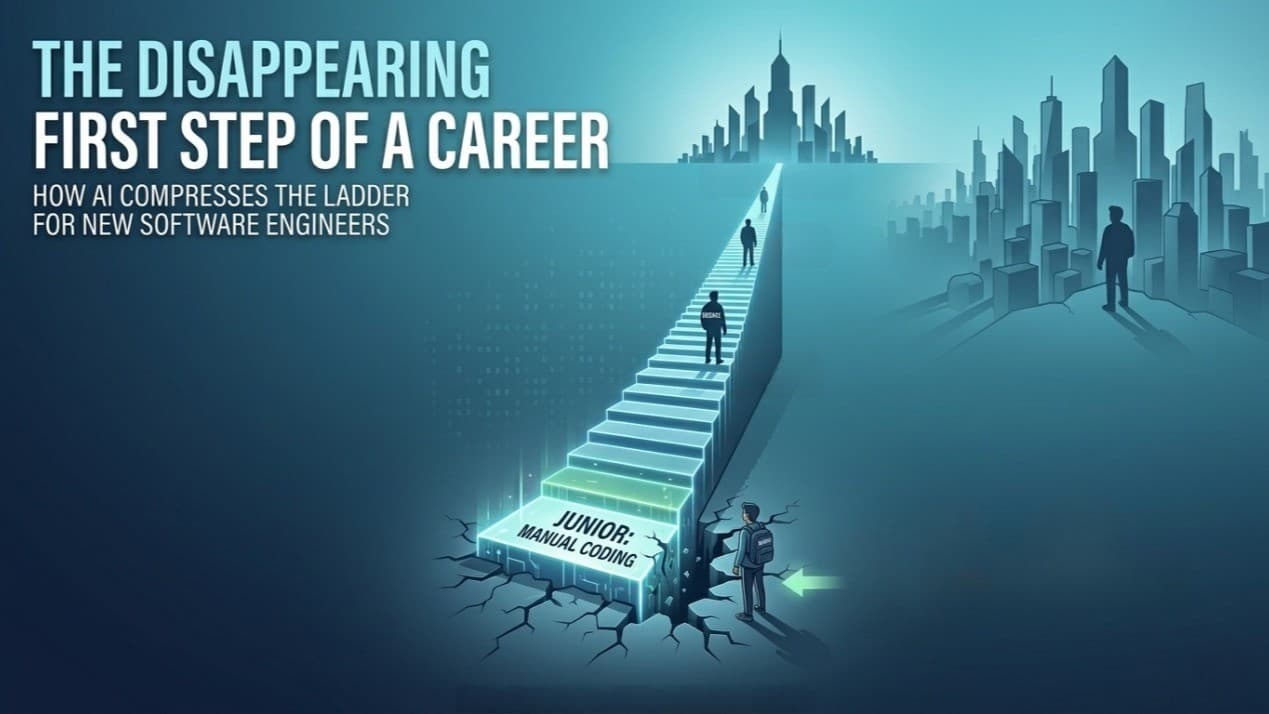
The software industry historically trained engineers through the implementation layer. Junior engineers wrote code, mid-level engineers designed components, and senior engineers designed systems.
That ladder existed because the work naturally supported it.
But AI compresses that ladder. If the implementation layer shrinks, the traditional entry point into the profession becomes smaller.
This is where the real tension appears.
The industry is already compressing the layer of work that historically trained new engineers. Not because companies stopped valuing talent, but because less manual execution is required to build software.
This creates a difficult moment for the industry.
Universities are graduating more computer science students than ever. Yet many programs still train students for a world where manual code production was the main constraint.
That constraint is rapidly disappearing.
The result is a structural tension.
Software creation is becoming dramatically easier, but engineering expertise is not becoming easier to develop. Experience still comes from seeing systems fail, scale, evolve, and operate in real environments.
That kind of judgment takes years.
Which leads to a difficult reality.
AI is expanding what we can build. But the pathway that once trained new engineers is becoming narrower.
Automation helped software scale execution.
Autonomation is beginning to scale decision-making. And now AI is starting to scale software creation itself.
That combination will reshape how software companies operate. It will reshape how engineering teams are structured.
And it may reshape how engineers enter the profession.
Powerful tools always follow the same rule. They amplify capability, but they also compress the need for large numbers of people doing the same work.
Software is entering that phase now.
The real disruption may not be how software is built.
It may be how narrow the path becomes for the next generation of engineers.
Related essays: Automation → Autonomation and AI Can Now Build Software. That Doesn’t Mean It Understands It.